
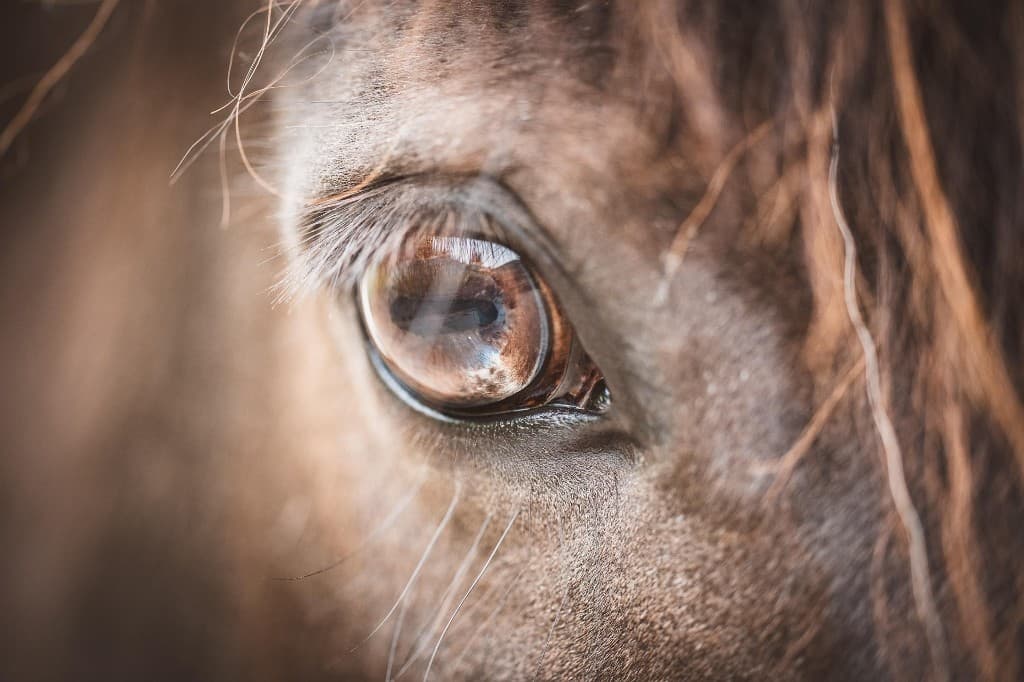
The horse is a prey animal, shaped by evolution to hide weakness.
The horse is a prey animal, shaped by evolution to hide weakness. That makes mental welfare one of the hardest – and most important – things to measure, and a field in which research has come a long way in recent years.
One of the most important scientific developments is the Horse Grimace Scale (HGS), a standardised system for reading pain from the horse's facial expression. The scale was first developed and validated in a study of horses undergoing routine castration, and showed promise as an effective and reliable method for assessing pain after the procedure. It has since been used in several clinical settings: a study of acute laminitis found that HGS is a potentially effective method for assessing pain in horses with acute laminitis at rest, because horses with high HGS scores also had higher scores on the established Obel scale and were judged by veterinarians to be more severely affected by pain.
One limitation of the method is that it depends on a human observer who must be well trained to apply the system correctly, and that the presence of an unfamiliar person can itself affect the animal's behaviour. That has led to research on automated image analysis: researchers have developed a machine-learning algorithm to assess pain level in horses on the basis of the Horse Grimace Scale, with the aim of monitoring pain responses more accurately and in real time.
Repetitive, functionless behaviours such as crib-biting, weaving and box-walking are well-documented indicators of reduced well-being. Research consistently shows that access to only small amounts of forage and minimal opportunities for social contact are linked to a higher reported incidence of stereotypic behaviour.
The scale varies sharply between different populations of horses. A study of racehorses across a training season found that 14.5 per cent of 353 horses observed showed stereotypic behaviour on at least two occasions, and that 34.8 per cent in total showed some form of abnormal or stereotypic behaviour. Still higher figures have been reported in other competition disciplines: 32.5 per cent in dressage horses, 30.8 per cent in eventers and 19.5 per cent in endurance horses, according to a frequently cited study.
Several factors work together. A review of the research notes that several studies of thousands of horses have consistently found a link between stereotypic behaviour and limited turnout, limited opportunities to socialise with other horses, and limited opportunities to graze or take in feed, often in combination with concentrate-rich diets. Stressful weaning, especially an abrupt weaning into an individual box, is also a risk factor.
The link with gastric problems is strong: research shows that gastric ulcers are common in more than 90 per cent of racehorses, and that young, growing horses with ulcers are more prone to develop crib-biting – in one study the time horses spent crib-biting fell when the underlying gastric disease was treated.
Research is relatively consistent on the solutions. A review notes that treatment of abnormal repetitive behaviours is centred on reducing the triggering factors – by improving the environment with suitable enrichment, reducing the amount of concentrates and increasing forage and daily turnout together with compatible horses – and stresses that punishing these behaviours is not a good idea, because it does not reduce the behaviour in the long term and can increase stress further.
At Hästannons we believe welfare and responsible ownership belong together – whether you buy, sell, breed or ride. Read on in the series, and in our practical guides.
A validated system for assessing pain from the horse's facial expression – used in clinical research and practice.
Stereotypic, repetitive behaviours often linked to insufficient forage, social contact and turnout.
No – the research is clear: punishment does not reduce the behaviour in the long term and can increase stress.
Social needs – often the most underestimated
Horses are strongly social herd animals, and research on breeding stallions illustrates the problem clearly: in the wild, stallions live in social groups, but under domestic conditions the majority of breeding stallions live in individual boxes with limited social contact, which tends to increase aggression and stereotypic behaviour.