
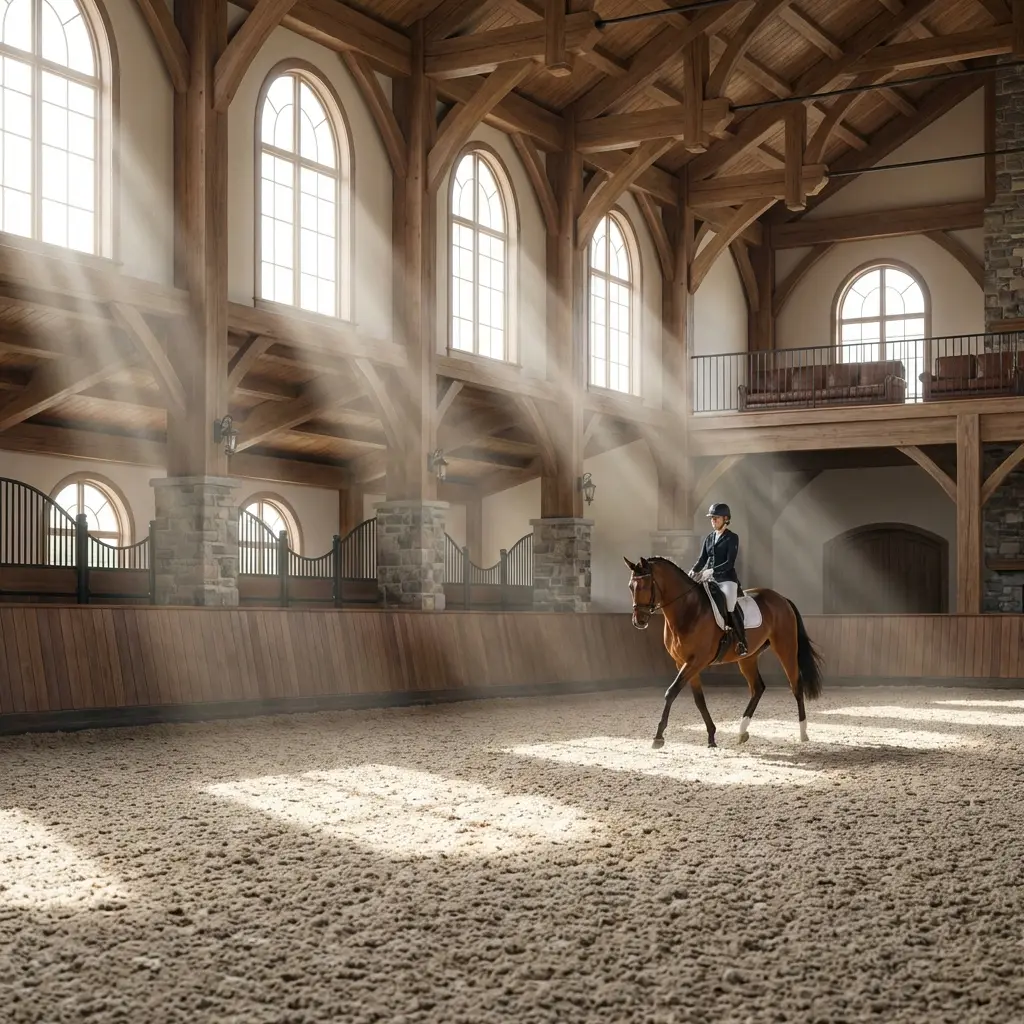
How to plan an indoor school, outdoor arena and paddock: the right size, surface and drainage, lighting and watering – and what applies to planning permission for a riding facility.
A well-built surface to ride on lengthens a horse's career and keeps schooling enjoyable all year. Whether you are planning an indoor school, an outdoor arena or a paddock, quality sits in the surface and the drainage. Here we go through sizes, how the layers are built, and what to settle before you start work.
An indoor school lets you train in any weather and through every season – but it is a serious investment. An outdoor arena costs less and will take you a long way if the drainage is sound and you can light the dark winter evenings. Many people start with a well-drained outdoor arena and add the indoor school later.
A good surface is built in layers: a stable, draining base and an elastic top layer that cushions and gives grip. The footing – often sand mixed with fibre or other additives – should hold moisture without turning heavy or dusty.
To ride through the year you need even, glare-free lighting – especially through the dark months. A watering system keeps a sand surface just moist enough to bind without kicking up dust.
A hardstanding, well-drained paddock takes pressure off the grazing and still lets the horse move when the fields are wet. Build it in layers just as you would an arena, and keep the surface clear of droppings to limit wear and parasites.
An indoor school is a large building and normally needs planning permission. Inside a detailed development plan (detaljplan) it is always required. Outside one, an indoor school can, exceptionally, be exempt as an agricultural building – but only if it genuinely belongs to a farm. An indoor school for a stand-alone training or hire business needs permission (see RÅ 2005:53, which concerned a riding hall). Outdoor arenas and paddocks can also need permission, depending on the site, the size and the groundworks. Always check with the municipality first.
The usual sizes are 20 × 40 metres for all-round schooling and dressage, and 20 × 60 metres for more advanced dressage or larger jumping courses. The 20-metre width is rarely worth compromising; fit the length to need, plot and budget.
The drainage. A surface is built in layers, with a draining base and an elastic top layer. Most problems come from poor drainage that leaves the arena boggy in rain or hard in drought. Invest in the base construction from the start.
An indoor school normally needs planning permission, and inside a detailed development plan it is always required. Outside one it can, exceptionally, be exempt as an agricultural building – but only if it belongs to a farm. A stand-alone riding business usually still needs permission. Outdoor arenas and paddocks can need permission depending on the site, the size and the groundworks. Always check with the municipality before you start.
Yes. Most sand-based surfaces need to stay just moist enough to bind and not dust. A watering system that spreads evenly, together with regular harrowing, keeps the arena in good order.